FitFuel

About Fitfuel
FitFuel is a self-led product concept exploring how AI can support more inclusive, approachable wellness experiences. The goal was to design an onboarding and workout planning flow that prioritizes motivation, accessibility, and long-term habit building over intensity or performance.
Over four weeks, I acted as the sole Product Designer, owning user research, competitive analysis, information architecture, visual design, prototyping, microcopy, and usability testing. I used AI tools such as Figma Make, Claude, Gemini, ChatGPT, and Lovable to accelerate exploration while keeping all product decisions human-led and intentional.
ROLE
Product Designer
TIMELINE
4 Weeks
Location
Remote
Tool Stack
Figma
ChatGPT
Claude
The challenge
Many fitness apps prioritize intensity and performance, which can feel intimidating or exclusionary for people looking for approachable wellness routines. This often leads to poor first-time retention, especially for older adults or users with mobility limitations. From a business perspective, this represents a missed opportunity in a large, underserved market that wants motivation without intimidation.
Constraints and assumptions
Limited scope: focus on onboarding + workout planner as core habit-building flows
No engineering support; all prototyping and testing were completed independently
Assumed FitFuel would prioritize inclusive design and accessibility over performance-driven fitness
AI would accelerate exploration but would still require human refinement
Research approach
I conducted competitive analysis across eight fitness apps to identify patterns of exclusion, tone, and onboarding friction. I used AI-assisted persona exploration to consider a wide range of ages, abilities, and motivations, and tested early flows with users to surface usability issues.
I focused on understanding:
How first-time users evaluate whether a fitness app feels “for them”
What language and visuals feel supportive rather than intimidating
What drives early engagement and follow-through
Key insights
Users feel overwhelmed by rigid, all-or-nothing workout programs
Older adults value clarity and reassurance over intensity
First-time retention depends on delivering value quickly
Flexibility and choice feel more sustainable than strict schedules
The opportunity
Users need a way to build consistent movement habits without feeling judged, overwhelmed, or left behind.
The business needs a differentiated, inclusive experience in a fitness market saturated with athlete-focused products.
The opportunity was to design a differentiated wellness experience that uses AI to deliver fast personalization, flexible workout options, and a supportive tone in a crowded fitness market.
Design goals
Help users complete onboarding in under two minutes without feeling overwhelmed
Deliver a personalized workout plan immediately after onboarding
Support accessibility across different ages, abilities, and comfort levels
Encourage first workout completion through clarity and reassurance
Measuring Success
Success indicators: high onboarding completion, positive usability feedback around tone and clarity, and strong first-workout engagement during testing.
Ideation
I explored multiple onboarding structures, workout filtering patterns, and tone-of-voice directions using rapid AI-generated screens in Figma Make and Lovable. I sketched variations of goal selection, time commitment, and workout preview layouts to understand how much choice felt empowering versus overwhelming.
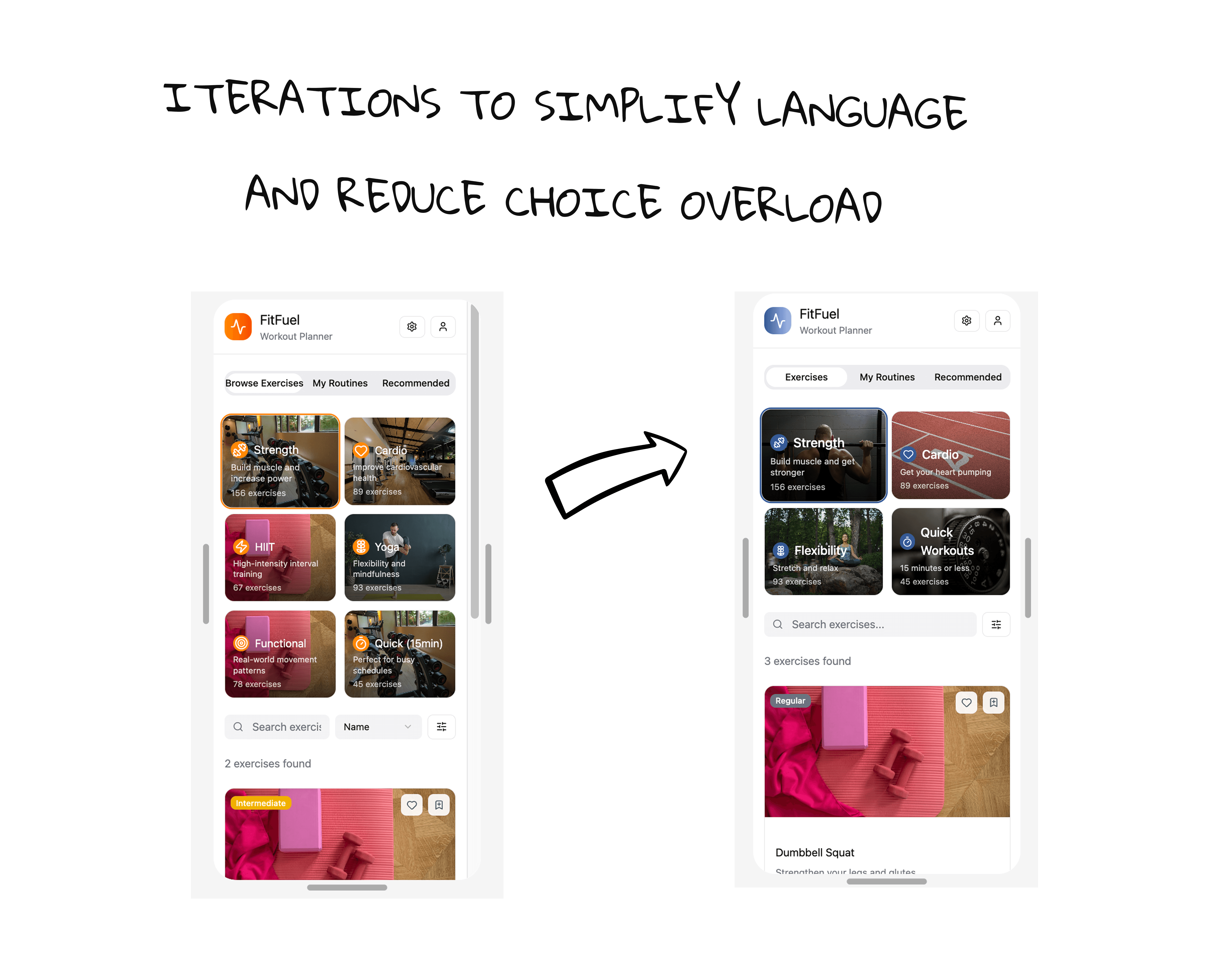
Early testing revealed confusion around fitness terminology, which led me to iterate quickly on clearer, more approachable microcopy and visual hierarchy.

Final Solution
Supportive Onboarding Flow
Flexible goal options (such as longevity, mobility, or general wellness) and time-based commitments reduce pressure and anxiety during onboarding.
AI-Personalized Workout Planner
The planner recommends one to three workouts per day based on goals, time, and ability, helping users start immediately without searching or decision fatigue.
Inclusive Visual & Verbal Design
Imagery and language intentionally represent diverse bodies, ages, and mobility levels to reinforce approachability and trust.
Gentle Progress Tracking
A simple progress view encourages consistency without guilt-based language or streak pressure.
Collaboration and Execution
Although the project was self-led, I approached it as if working cross-functionally by documenting flows, defining clear acceptance criteria, and creating developer-ready annotations. AI supported speed and exploration, but final decisions were always evaluated for clarity, feasibility, and ethical use.
Usability Testing and iterations
I tested the onboarding and workout planner with three users and supplemented findings with AI-simulated feedback to identify friction points.
Key iterations included:
Simplifying fitness terminology
Reducing visible workout options to avoid overwhelm
Designing with future accessibility needs in mind, such as larger text options
Results and impact
All testers completed onboarding without guidance
Users described the experience as “gentle,” “welcoming,” and “easy to start”
Task completion improved after iterations, especially around finding appropriate workouts
Peers and instructors noted strong alignment between the product’s tone, UX, and visual system
AI tools accelerated exploration and iteration by approximately 70%
Next steps
Expand personalization to include nutrition and sleep recommendations
Run longitudinal testing to understand habit formation over 2 - 4 weeks
Partner with physical therapists to expand seated and mobility-specific workouts
Validate onboarding flow with a larger accessibility-focused cohort
Reflection
This project deepened my understanding of how AI can accelerate design without replacing intentional product thinking. It strengthened my ability to design for inclusivity across ages and abilities. Most importantly, it taught me how to balance speed with empathy, two things that shape my work today.